|
|

Schwarzenegger, Buffett and California’s dam futureSchwarzenegger pushes to build new dams while an unlikely coalition battles to tear down existing ones
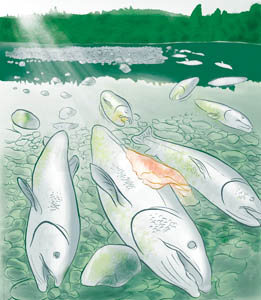
By Dan Bacher The governor has attempted to revive the long-stalled plans to build the new dams and the canal ever since he was elected, but like the declining number of salmon returning up the Sacramento River from the sea, he has found himself swimming against the current. That hasn’t pleased two groups of Schwarzenegger’s primary financial backers, agribusiness and real-estate developers. And two dry winters in succession provided the governor the opportunity to raise the issue once again at a June 4 press conference, at which he proclaimed a statewide drought and ordered “immediate action to address the situation.” That is, build new dams and a canal, by any means necessary, including ballot initiative. Meanwhile, on the California-Oregon border, in the wake of a dramatic, nationally reported fish kill in 2002, the unlikely coalition of fishermen, American Indians and environmentalists has successfully made its case to tear down four dams on the Klamath River. In this case, the courts, the state and Schwarzenegger himself have indicated support for dam removal. The only person standing in the way? Just the world’s richest man, billionaire investor Warren Buffett, who holds a controlling interest in the dams. At the center of the squall is the chinook salmon. For thousands of years, the anadromous fish has helped sustain the indigenous people on the North Coast and in the Central Valley. After Euro-Americans came, it helped spawn a vital commercial fishing industry. Now, its very existence is imperiled, thanks in large part to the voracious thirst of the state’s growing population. It’s a cliché to call the salmon the canary in the coal mine, but that’s what it is. The Klamath and Sacramento rivers are part of the same ecosystem. Commercial fishing has been halted off the North Coast in the Klamath Management Zone, because fishermen might catch the imperiled Central Valley chinook. Today, the interconnection of the water system is even more apparent due to modern engineering that permits vast transfers of water from one region to another. Water from the Trinity River, the Klamath’s major tributary, can be piped through the Sacramento River all of the way to Westlands Water District to Beverly Hills. But critics of the system say we’re robbing Peter to pay Paul. The salmon, they say, are trying to tell us how much is enough. The Governator strikes again The novelty of the action hero-turned-governor may have worn off, but at the press conference June 4, the media’s love for the always quotable Schwarzenegger was evidenced by the crowded room full of television, radio and print journalists from across the state and the nation gathered before the oracle of yet another slickly produced pronouncement.
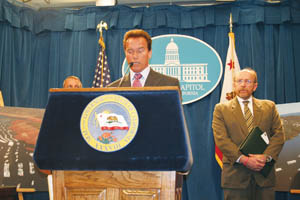
He arrived at the podium flanked by Lester Snow, director of the California Department of Water Resources, and Ken Pimlott from the Department of Forestry and Fire Protection. First, Schwarzenegger painted a dramatic picture of the devastating drought he was declaring. Then, once again, he trotted out his annually rebuffed solution, voluntary water conservation and the building of two new dams—Temperance Flat on the San Joaquin River and Sites reservoir on the west side of the Sacramento Valley—combined with “water conveyance,” a euphemism for the peripheral canal that California voters shot down in a landslide vote in 1982. “Over the last two years, California has suffered from low rainfall, low snowpack and court-ordered restrictions on pumping from the Delta that supplies most of the water,” Schwarzenegger said. “March, April and May have been the driest in the record history. As a result, some of the local governments are rationing water, developments can’t proceed and some agriculture fields sit idle. And on Monday, San Joaquin farmers suffered another blow when federal officials cut their water supply even further.” The final snow survey of 2008 by the Department of Water Resources showed snowpack water content at only 67 percent of normal and the runoff forecast at only 55 percent of normal, the governor said. He argued that allowing “excess” storm water to run off into the ocean without being captured for “productive use” is intolerable—neglecting to mention the important role freshwater storm runoff plays in sustaining the San Francisco Bay-Delta Estuary and salmon fisheries up and down the West Coast. “This drought is an urgent reminder of the immediate need to upgrade California’s water infrastructure,” he said. “While we cannot control Mother Nature, what we can control is to prepare ourselves for future dry years.” Schwarzenegger reminded reporters that for the last two years, as part of his Strategic Growth Plan, he has proposed a comprehensive water solution, including $3.5 billion for above-the-ground and below-the-ground water storage, upgrading the water delivery system and fixing the Delta’s ecosystem. The governor and state Sen. Dave Cogdill’s $11.9 billion water bond failed it to make it out of the Legislature last fall during the special session that Schwarzenegger declared due to opposition from Democrats. Since then, the governor has tried to revive the proposal in negotiations with Sen. Dianne Feinstein. “Are you prepared to bypass the Legislature and go straight to initiative if that’s what it takes?” asked one reporter. “Well, if that’s what it takes,” the governor responded. “I don’t see water as a political issue. I think that there are Democrats that want to drink safe and reliable water, and there are Republicans that want to drink safe and reliable water, and they want to have a guarantee that they’ll have water 20, 30 years from now.” Evoking the populist surge that got him elected governor in the recall election of 2003, Schwarzenegger concluded by saying that providing water to Californians “shouldn’t be a party issue, it should be a people’s issue, and it should be an issue that is facing farmers and business people. Ordinary people, everybody is suffering when we have no water.” On that score, the governor ironically finds himself in agreement with some of his water policy’s fiercest critics. Enter the blue-collar panel The battle to restore the Klamath River and California Delta has brought together folks who often times have been at odds with one another—American Indian tribes, commercial fishermen, recreational fishermen, farmers and environmentalists. All must work together to make sure there is enough water for sustainable farms, sustainable fisheries and the cultural traditions and ceremonies of California’s American Indian tribes. Troy Fletcher, a Yurok tribal member and natural resources consultant for the tribe, who noted that little headway had been made despite numerous studies that have been conducted, has helped rally the disparate groups that depend on the salmon and the water for their livings together. “What we need is not another blue-ribbon panel, but instead a blue-collar panel with the guys and gals who get their hands wet, whose hands touch the water,” Fletcher said. “On these issues that impact us, it’s always somebody else that makes the decisions—the federal and state governments or other agencies. We have to get the people who are directly impacted engaged in making the decisions.” More than any other single event, the 2002 Klamath fish kill has galvanized tribes, commercial fishermen, environmentalists and farmers to work together. An estimated 68,000 fish died, in addition to the hundreds of juvenile salmon that perished in the river because of low, warm flows spurred by a Bush administration change in water policy that favored Klamath Basin farmers over fish, the tribes and fishermen.
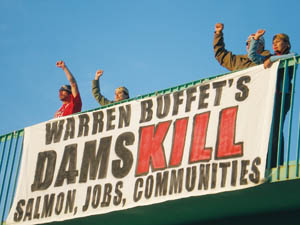
The unlikely coalition has demanded the removal of four PacifiCorp Klamath River dams owned by Warren Buffett subsidiary MidAmerican Energy, contending that they kill salmon and create massive blooms of toxic algae. On May 3, for the second year in a row, they went to Warren Buffett’s Berkshire Hathaway annual shareholders meeting in Omaha, Neb., to convince the multibillionaire to remove the dams. Although Buffett rebuffed dam removal advocates just like he did when they attended last year’s meeting, this year’s actions made the Klamath River the largest single issue addressed at the meeting. Wearing shareholders badges, three dam removal advocates stepped up to the microphone to deliver their message to Buffett, the world’s richest man, in a packed convention center that included Bill Gates, the world’s second richest man, and a crowd of 31,000 shareholders.
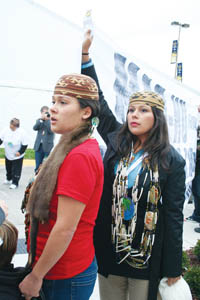
Chook-Chook Hillman, a 23-year-old Karuk World Fatawan [renewal priest], who fasted last year with other young world renewal priests in an unsuccessful effort to force a meeting with the tycoon, introduced himself in the Karuk language and challenged Buffett. “As a European-American, you are the visitor in our country. Will you not meet with the native people impacted by your fish-killing dams?” he said. “You say you want to address poverty and disease in the Third World, but you are creating those same Third World conditions right here in America. We want to meet and resolve the issue in a way that saves you money and saves our culture!” He then presented a dam removal agreement for Buffett to sign as Yurok tribe members Georgiana Myers and Annalia Norris unfurled a large banner that read “Klamath Dams Equal Cultural Genocide.” Buffett responded, as he has in the past, that the issue is out of his hands: “I’m prohibited from speaking out by an agreement that we signed with FERC [Federal Energy Regulatory Commission]. However, there is strong disagreement in your area about this issue.” He then deferred the question to MidAmerican CEO David Sokol, who echoed, “It would be inappropriate for Buffett to comment on Klamath relicensing. “We would be pleased to move ahead with a solution when the 28 parties agree on a solution,” Sokol said, claiming that the dam relicensing process is complex. “If public policy moves in the direction of the removal of dams, fish ladders or the status quo, then that would be where we go. It is a complicated situation where a cooperative solution is needed.” Sokol acknowledged the existence of the toxic algae, but dismissed the role of the dams in creating the algae and blamed the high-nutrient load in the river on Klamath Basin agriculture. Like Schwarzenegger, Buffett swims against the current. The California Energy Commission largely agrees with the fishermen and the tribes. After reviewing data from a 50-page filing submitted by PacifiCorp recently to the FERC, the commission issued a report last year saying that removing the dams and purchasing replacement power would cost $114 million less than the costly relicensing process and installing expensive fish ladders. “PacifiCorp must choose the alternative that makes the most economic sense for its ratepayers,” commented state energy commissioner John Geesman. “Using PacifiCorp’s own numbers, the new analysis clearly indicates that it is best for the ratepayer that these four dams be removed.” PacifiCorp, one of 60 Berkshire subsidiaries throughout the world, serves 1.7 million customers in six Western states. At press time, PacifiCorp, the federal government and the states of Oregon and California were in talks over how to resolve a proposal to remove four hydroelectric dams on the Klamath River. After the lunch break, Buffett, clearly upset by the morning’s proceedings, refused to entertain any more questions on the topic. Commercial salmon fisherman Dave Bitts, traditional Karuk dip-net fisherman Ron Reed and Karuk medicine woman Cathy McCovey were denied access to the microphones despite being next in line to speak. Bitts, a commercial salmon troller out of Eureka and president of the Pacific Coast Federation of Fishermen’s Associations, was fuming. “I traveled over 3,000 miles to be here and woke up at 2 o’clock in the morning to speak—then I was told I couldn’t speak,” he said. “The story I have to tell is that of an out-of-work commercial fishermen. Buffett spent a lot of time today explaining what he couldn’t do for us. I wanted to ask the richest man on the planet what he could do for us.” Defending the Delta The successful battle by the Hoopa Valley tribe, recreational fishing groups and commercial fishermen to pressure SMUD, Palo Alto, the Port of Oakland and other cities to pull out of a lawsuit blocking restoration of the Klamath left Westlands Water District isolated. A federal judge in July 2004 ordered that the river be restored—and that victory paved the way for similar broad-based coalitions to be built on the California Delta and on the Klamath. Members of the coalition were quick to pronounce their disagreement with Schwarzenegger’s proposed solution to the drought. Traci Sheehan Van Thull, executive director of the Planning and Conservation League, criticized Schwarzenegger for using “outdated strategies” to deal with the water crisis. “Governor Schwarzenegger’s drought proclamation offers up a challenge—and an opportunity—for all Californians to conserve water and to work together to find new solutions to solve our water problems,” she said. “Unfortunately, the governor’s executive order relies heavily on outdated strategies that have created the very problems we now seek to solve.”In regard to the construction of new dams and the peripheral canal, fishing groups, environmentalists and tribes frequently cite a report compiled by the Pacific Institute in September 2004 that contends California could meet all of its water needs without building dams. The state could cut its wasteful use of water by 20 percent in the next 25 years while “satisfying a growing population, maintaining a healthy agricultural sector, and supporting a vibrant economy,” according to the report. The analysis—in sharp contrast to the Department of Water Resources 2005 Draft California Water Plan—details how smart technology, strong management and appropriate rates and incentives can allow the state to meet its needs well into the future with less water. “We need a new approach to California’s water woes,” said Peter H. Gleick, president of the Pacific Institute and the report’s co-author. “The good news is that California can meet the needs of farmers, businesses and a growing population well into the future without massive and destructive infrastructure projects—if we take a smarter, more efficient approach to water management.” Bill Jennings, chairman of the California Sportfishing Protection Alliance and former Deltakeeper, likewise blasted Schwarzenegger’s call for more dams, pointing to the California Supreme Court Bay-Delta decision that was filed the same week as Schwarzenegger’s press conference. “I encourage the governor to read the decision,” said Jennings. “I think there is a disconnect between the governor’s office and the California Supreme Court.” The decision is at odds with the governor’s push for dams. In very unequivocal terms, the ruling states, “The decision to concurrently pursue each of CALFED Program’s objectives means that no additional storage will be built, no new stream diversions will occur and Bay-Delta water exports will not increase, unless accompanied by measurable progress in restoring the Bay-Delta ecosystem.” “The plan to build more dams is just another raid on the taxpayer’s money,” said Jennings. “There is certainly nobody that will buy the water at the cost of storage and delivery. Not only is it a raid on Northern California water, but it is a raid on the pocketbooks of the taxpayers to provide subsidized water to grow subsidized crops in a desert that requires subsidized drainage to control pollution from land that should have never been cultivated in the first place.” Fishing groups were also critical that the governor’s order and press conference didn’t mention anything about the need to restore four pelagic (open-water) fish species on the Delta—Delta smelt, striped bass and threadfin—or the collapsing Central Valley fall chinook population impacted by massive increases in water exports. While agribusiness, industry and municipalities face water shortages this year, fish advocates argue that Central Valley fall-run chinook salmon and California Delta fish species have already faced a “man-made” drought, in spite of some good water years, since 2002. “I didn’t see anything calling for the protection of fish anywhere in his declaration,” observed Dick Pool, president of Pro-Troll fishing products and coordinator of Water for Fish, an organization working to restore California’s fisheries. Jennnings emphasizes that largest annual water-export levels in history occurred in 2003 (6.3 million acre feet), 2004 (6.1 MAF), 2005 (6.5 MAF) and 2006 (6.3 MAF). Exports averaged 4.6 MAF annually between 1990 and 1999 and increased to an average of 6 MAF between 2000 and 2007, a rise of almost 30 percent. More dams and a peripheral canal designed to increase water-export capacity will only aggravate this problem, fishing groups say. Mark Franco, headman of the Winnemem Wintu tribe, approaches the dams and canal issue from another angle: To him, Schwarzenegger’s concept of building more water-storage facilities and the peripheral canal to “restore” the Delta goes against the very core of indigenous people’s concept of the Earth.“Traditional people see the Earth in balance,” said Franco, whose tribe conducted a war dance at Shasta Dam in 2004 to oppose the proposed raising of the dam by the Bureau of Reclamation, and in 2005 committed themselves to the battle to restore the Delta. “If you take something from the Earth and don’t replace it, it takes everything out of balance. For example, our McCloud River salmon were introduced many years ago to New Zealand where they are now thriving, but the salmon are no longer in the McCloud. They shifted the balance—and the salmon are now in collapse.” The proposed raising of Shasta Dam, which the tribe adamantly opposes because it would flood the tribe’s remaining sacred sites, is an integral part of state and federal government plans to increase water exports out of the Delta via the peripheral canal. “The rivers are the arteries of the Earth,” he noted. “Building more dams and a peripheral canal to save the Delta is like putting a tourniquet on your arm and leaving it there. If you don’t take it off, you will die.” Old-school salmon cook-off
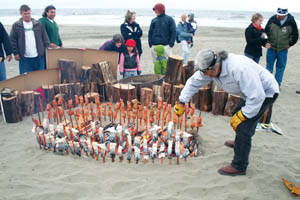
Several weeks after the protest at Buffett’s Woodstock of Capitalism, Ron Reed and a crew of members of the Yurok, Hoopa Valley and Karuk tribes visited Ocean Beach in San Francisco to kick off the first ever SalmonAid Festival in Jack London Square. There, they baked salmon the traditional way, on redwood sticks over an open fire. Drawing the close connection between fishery failures on the Klamath and Sacramento, Reed said, “The time has come for real solutions, like curtailing pumping fresh water from the Bay-Delta and the removal of Warren Buffett’s lower four Klamath River dams.” The SalmonAid Festival followed the declaration of a “fishery disaster” by U.S. Secretary of Commerce Carlos M. Gutierrez on May 1. This year, for the first time in history, commercial and recreational fishing in California and Oregon has been closed by state and federal regulations. Although the immediate cause of the fishery failure this year was the unprecedented collapse of Central Valley chinook salmon, just two years ago, salmon fishing was severely restricted because of the decline of Klamath River chinook salmon spurred by the fish kills of 2002. To the Karuk and other American Indian tribes, the river is more than just a stream. And the salmon is much more than just a fish. It’s an integral part of their religion and culture. Reed, who traditionally dip-nets salmon below Ishi Pishi Falls on the Klamath above Orleans, has been instrumental in drawing diverse groups of fishermen, American Indian tribes, environmentalists and farmers together to lobby for dam removal on the Klamath and has spoken often at rallies to restore salmon runs on the Sacramento, Klamath and other West Coast rivers. “As a traditional fisherman at Ishi Pishi Falls, when I hear of a farm bankruptcy in the basin, that’s no good,” emphasized Reed at a Klamath River conference in Scotts Valley in 2003. “That doesn’t give me more water or more fish. We need to manage the Klamath River as a precious resource—and the polarization in the basin has to stop!” The broad coalition of tribes, commercial fishermen and environmentalists that went to Omaha to protest Buffett’s dams is paralleled by Restore the Delta, a similar banding together of Delta farmers, Delta business people, recreational fishermen and American Indian tribes. Many from both camps believe their efforts will ultimately save the California Delta and restore the Klamath River. Caleen Sisk-Franco, spiritual leader of the Winnemem Wintu tribe, summed up the urgent need for sustainable use of water and resources so that dwindling stocks of salmon and other fish can be restored—and the need for a new way of looking at water, dams and the environment. “Shasta Dam blocked over 200 miles of cold water tributaries, including the McCloud River where we lived for thousands of years,” she said. “Our lives changed when we could no longer catch wild salmon on the McCloud, and so will yours when salmon are no longer available. “Unless people do a complete paradigm shift, there will be no more salmon. If we don’t put water for fish as the top priority, we will lose wild salmon. We can’t live without the salmon, and we won’t be here when the salmon are gone.”
|